


Fodder beet has become a key crop for dairy farmer Dylan Davies in recent years, underpinning his strategy to outwinter youngstock to help keep costs in check.
Ensuring an adequate supply of crop nutrients, particularly during periods of high demand, is vital to achieve the beet yields he needs.
Dylan runs 250 dairy cows plus followers at Cwmporthman Farm, Blaenporth in Ceredigion. He grows 200ha of grass, maize and fodder beet with advice from Agrovista/CCF Agri agronomist Lyndon Harris.
“We’re focused on crops that suit our locality and can really yield,” says Dylan. “We have 500 head of stock, which is a lot of mouths to feed, and costs are always rising.”
Although rainfall is high, averaging around 1200mm a year, soils are shallow and free draining. “It’s a relatively dry farm and we are right on the coast, so winters are quite mild,” says Dylan.
“We are lucky in that respect – we rear all our own replacements, so rather than build a lot of infrastructure, which we would only use from November to February, we can outwinter all our in-calf heifers and some bulling ones on fodder beet.”
The crop is well suited to Cwmporthman Farm. It thrives in wet, cool conditions and can cope well with shallow soils as is it not particularly susceptible to compaction.
Balanced ration
Youngstock start grazing fodder beet at the end of November/beginning of December. “The crop provides a balanced ration – protein from the tops and energy from the roots,” says Dylan.
Fodder beet continues to grow throughout the winter. Yields of Jamon, a soft-fleshed variety bred for grazing, start at 60t/ha or more, but usually hit 100/ha towards the end of the season.
“It’s pretty much bed and breakfast in one field,” he adds. “We only grow 14 acres but that keeps 60 heifers fed through to April, buffered with a bit of hay or silage behind them.
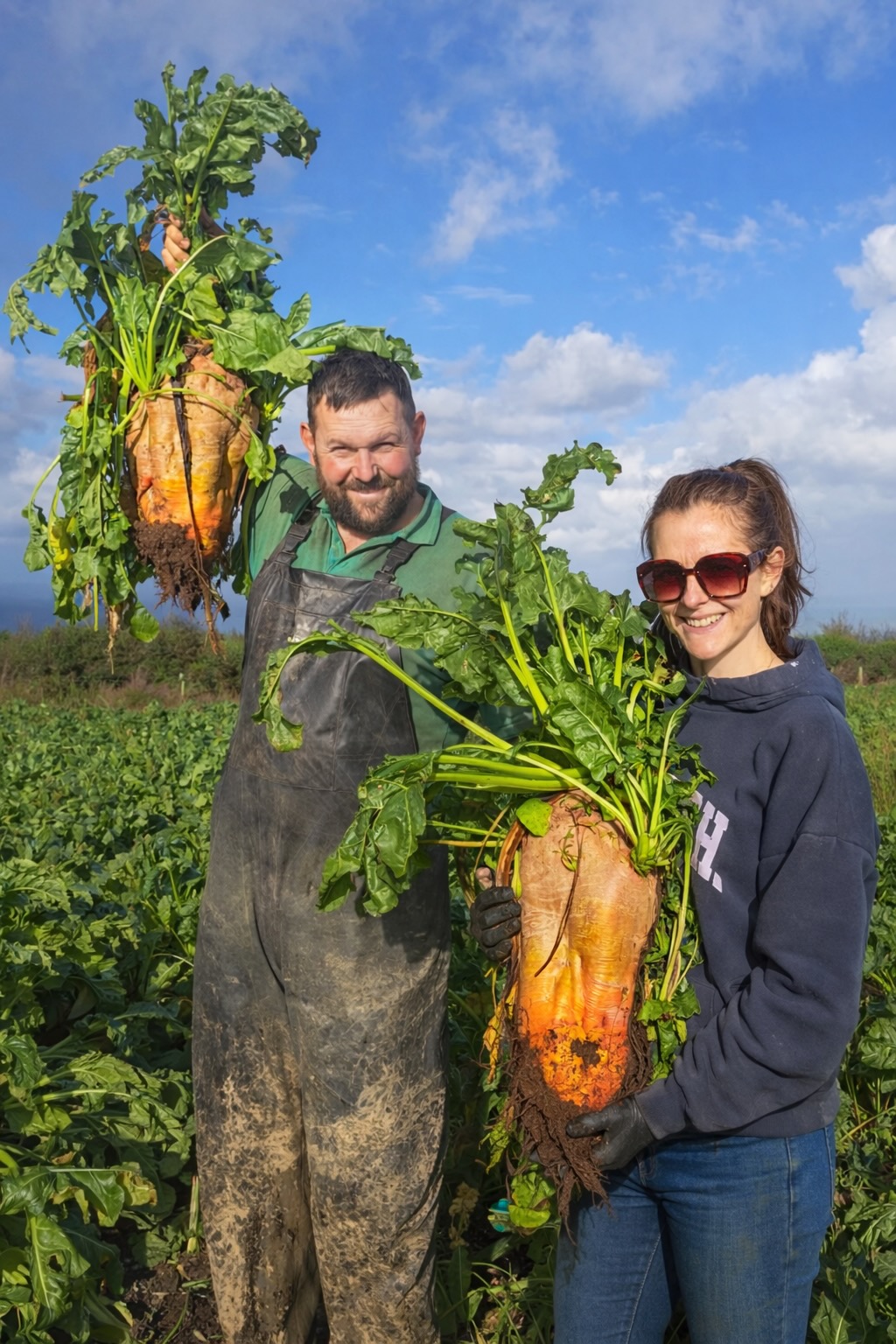
“Last year was probably the best yield we’ve had; we smashed through the100t/ha benchmark,” says Dylan. “You could have mistaken the beet for pumpkins.”
Building yields
Maximising root development and leaf cover in the first two months helps to build yields, Lyndon notes. “We have achieved high output through careful early weed control when the crop would be prone to competition and by ensuring that we apply the correct nutrients at the right time,” he explains.
As with all crops, sufficient supplies of major and micronutrients are key. Boron can be deficient in lighter soils, where Lyndon recommends applying it as agricultural salt containing boron, which is stocked by CCF Agri specifically for fodder beet, and in the foliar form with herbicide.
Retaining green leaf is crucial to raise yield in later harvested or grazed crops. “Two fungicides and a late application of nitrogen are well worth considering,” says Lyndon.
Potassium pinch point
Potassium is important for leaf development and photosynthesis and other functions that affect growth and reproduction, so deficiency can soon have serious effects.
The main pinch point for potassium comes during bulking. “The crop has a huge demand for potash during this period, more than any other fodder crop we grow,” says Lyndon. “It can struggle to draw enough out of the soil to meet that demand.”
To prevent that, Lyndon uses Wholly K, a highly efficient potassium foliar fertiliser from Agrovista’s Innovation Range that maximises delivery to the crop. The product also contains L-PGA (pidolic acid) to enhance nitrogen assimilation.
“I find Wholly K very helpful in this situation, typically combined with fungicide and applied in July and again with the second fungicide a month later,” says Lyndon. “ “Alternatively, it can be used in June with a post-emergence herbicide and again with the fungicide.”
Cheap insurance
Over the last few years fodder beet yields have increased at Cwmporthman Farm, and Lyndon has been using Wholly K for the past three of those years. “It is very difficult to say how much of that increase is due to the product. But Dylan is getting very good yields and it is definitely part of the story,” he says.
“At the very least it offers cheap insurance, particularly when crops might be struggling to access potassium, and is something we will continue to use.”
Last year was a major step-up for fodder beet yields on the farm, Dylan adds. “And that was after a very dry summer – if the crop can yield like that we will be looking to grow more of it.
“I always challenge Lyndon to increase yields and as part of that I’m happy to try new ideas, and Wholly K is one of those. If he recommends something it’s worth a go.”