
ForOurGrowers Events Literature Insight Vegetable Amenity
Zone mapping

Zone mapping

Zone mapping utilises either soil variation or field variation maps.

Predetermined soil sampling points are set within soil type or productivity zones.

Basing soil sampling on variation maps is not only a more effective use of the variation maps but also adds greater accuracy to your nutrition variation.

Service use

• Variable rate P, K, Mg and pH

• Zone scans not included

Benefits

• Highly accurate results

• Identifying areas which require less/more nutrient

Some soil types have the ability to hold certain nutrients better than others and a site-specific point within a zone will show this.

However, variation can also occur within a particular zone, therefore overlaying 1ha grids over the variation maps is the most accurate way to determine nutrient levels. Each sample will still consist of a minimum of 16 cores.

What is involved

  1. Utilise previous soil type scans or field productivity scans to accurately place soil sample point

  2. The sampler is guided to each sample point to collect 16 sub-samples

  3. The sampler is able to relocate sampling points due to factors that could lead to inaccurate readings, such as cattle feeders, muck heaps or wet holes

  4. Samples are logged and sent to the laboratory for analysis

"The first field resulted in a saving on P and K of £18.50/ha, a figure that Stuart says is typical across the farm’s light soils. “I thought the equipment had stopped working in one field – I had to travel three-quarters the way around the headland before it started spreading. “It just shows how much we have been overapplying. We’ve used a total of 455kg of TSP and 160kg of MOP on 38ha, compared with the 1500kg of compound we used on the same area last season, a saving of £700. That’s significant, and at current prices would be considerably higher. The service has already paid for itself – just think what a bigger unit could save.”"

Stuart Dickin, P & J Dickin & Son

Information required for application data

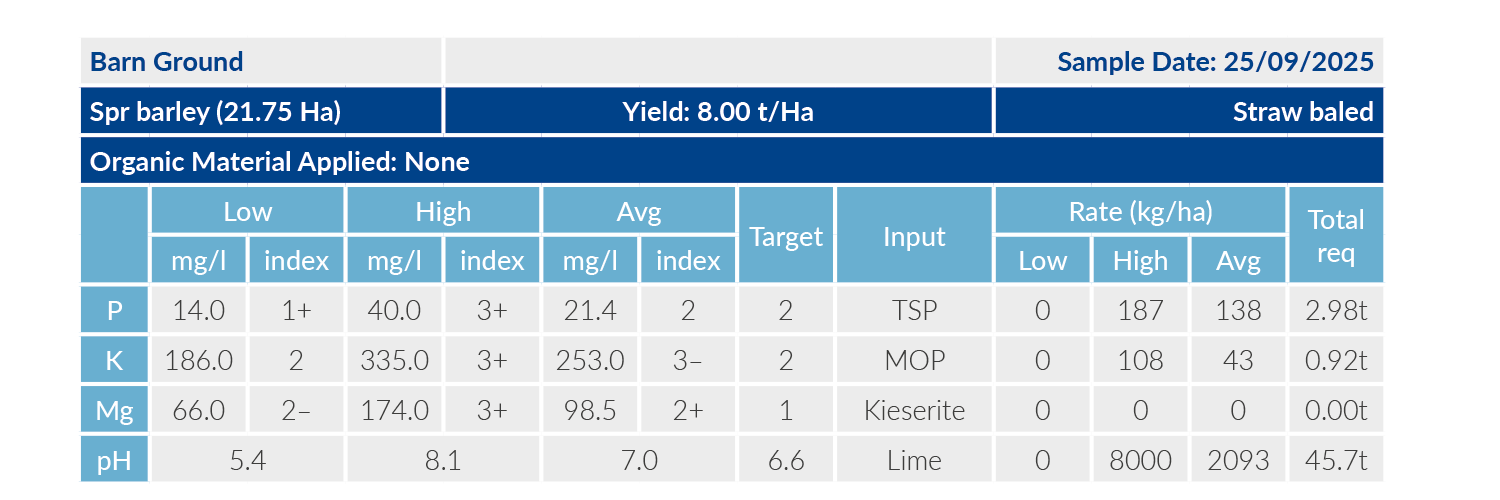
  1. Type of analysis – standard is S1 (P, K, Mg and pH). Further nutrients can be added for an additional fee. Two popular additions are Ca and organic matter

  2. Cropping – to create a fertiliser recommendation the precision team require cropping, yield, target pH, muck information and straw policy

  3. Once these reports have been created it is then time for a discussion with the grower and agronomist

The cropping form should be updated yearly for new recommendations. Four years of recommendations are supplied with this service.

Application maps can be made for all major manufacturers’ equipment. Your precision specialist can advise on file type and format.

This service can also be loaded onto the Agrovista portal ‘Insight’. For a greater depth of knowledge, it is suggested that a broad spectrum Solvita analysis (a measure of soil biology) is carried out for the whole field.

Standard services include

  • P, K, Mg and pH maps

  • Four years of recommendations

  • Data interpretation

  • Application files

  • Soil variation scans NOT included

Precision Farming

The information you are submitting will only be used in relation to your enquiry. By continuing to submit you are granting Agrovista permission to store and process your data in accordance with our Privacy Policy ​.

REF: AGV/GIT/1.1