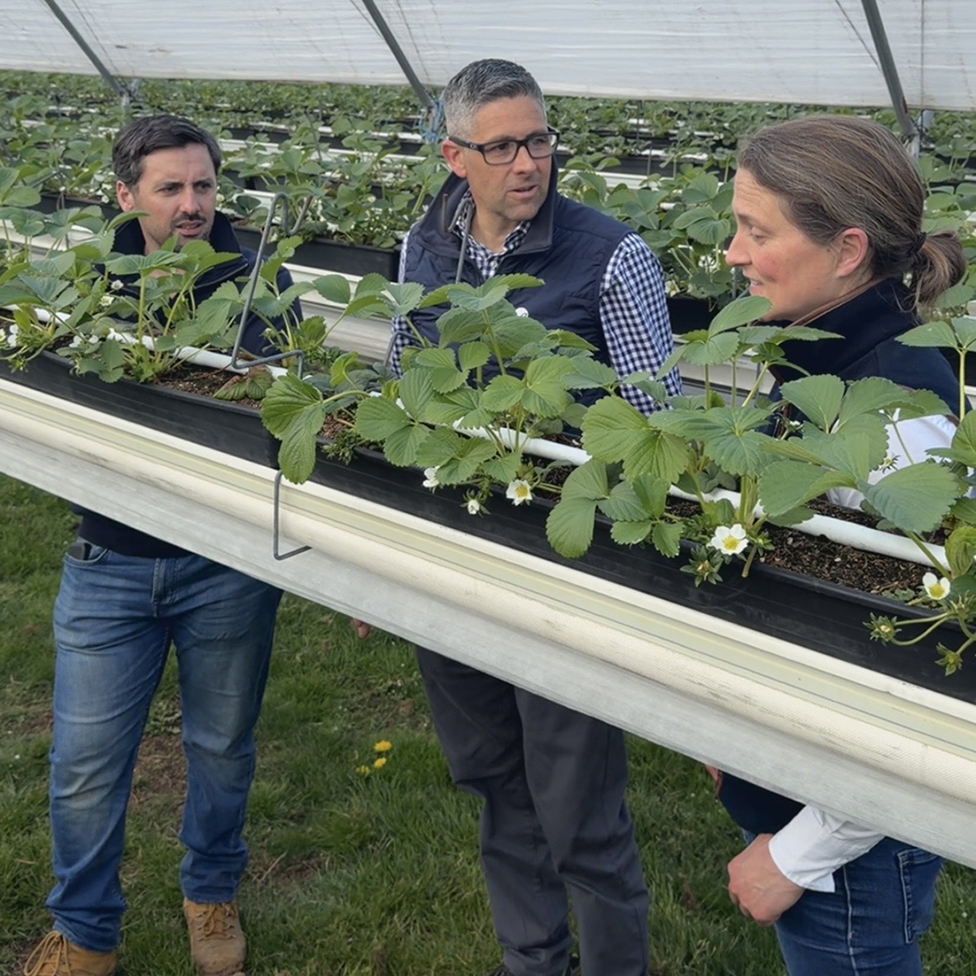


Using a water conditioner is helping a large strawberry grower manage salt accumulation in growing substrates more effectively.
Makin Soft Fruit, home of the Annabel’s Deliciously British brand in West Yorkshire, produces around 2200t of strawberries and 20t of raspberries annually, supplying Marks and Spencer, Sainsbury’s and Aldi, explains director Chris Jones.
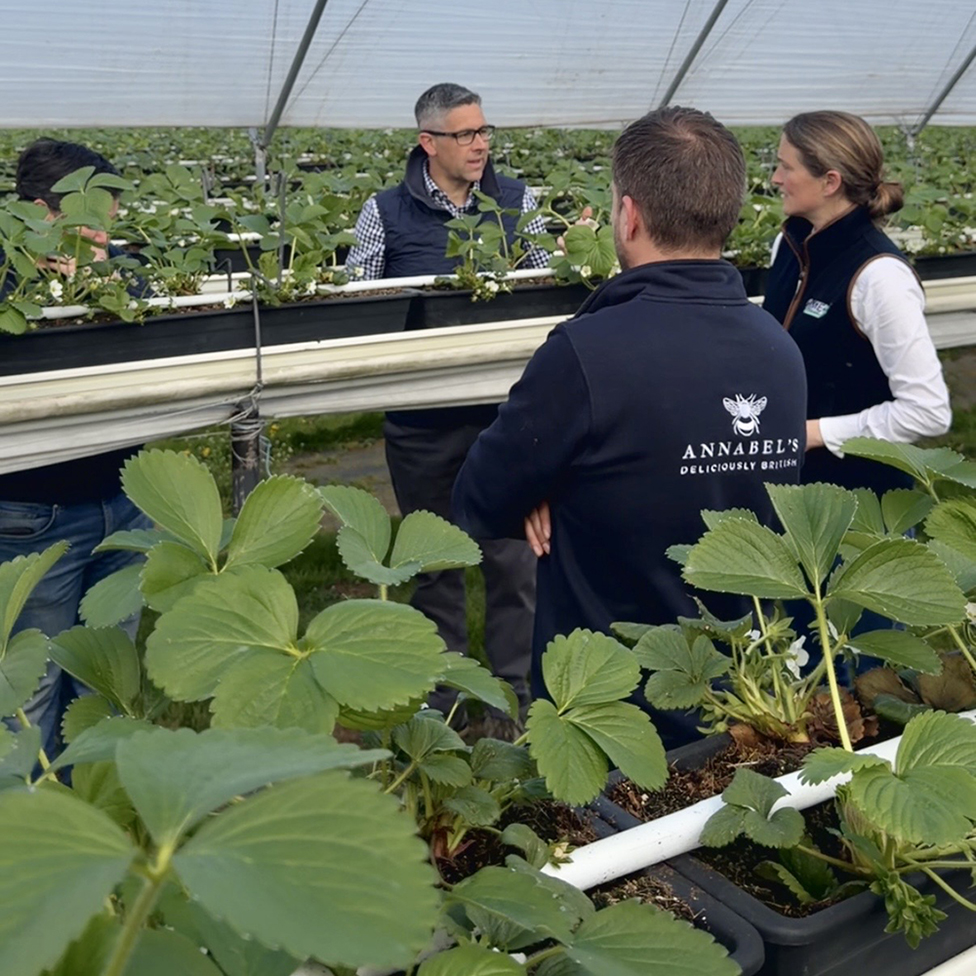
The 55ha production is all in polytunnels using a hydroponic system, making water quality paramount. Rainfall is harvested from the farm’s buildings and yards into a lagoon. But when the level drops below a certain level, it’s topped up by borehole water, Makins Soft Fruit director Chris Jones explains.
“The idea is that it blends with good quality rainwater in the lake, before being drawn into the irrigation system.”
Unfortunately, with the farm sitting on limestone and almost certainly sealed coal mines, the quality of the borehole water is relatively poor, with farm testing showing it contains increasingly high levels of salts, including sodium, chloride and sulphates.
Dry weather, like experienced both last spring and in April this year compounds the challenge, forcing the farm into heavier reliance on borehole water.
“Last year we started using borehole water in April compared with May or June usually,” recalls Evgeni Genov, assistant manager at Makins Soft Fruit. “We were relying on borehole water virtually the whole season because it was dry.”
High salt levels in the coir growing substrate creates a lock up effect, where the unwanted ions prevent the plant from taking up essential nutrients that can only be supplied with the irrigation water.
“What we find with feeding with the irrigation water is, especially when the weather gets warm, the plant will take up more water and will dump the nutrients leading to a build-up of electrical conductivity (EC),” explains Agrovista fruit agronomist Simon Warren, who advises the business.
“If the EC gets too high it causes plant stunting, small fruit and poor flavour. Salt will also affect the root system.”
The traditional method of solving this problem is flushing the entire system with calcium nitrate once the EC level gets too high, which displaces the salts.

But that means turning off all other nutrients for a period of time, including potassium, Evgeni says. “And that means your fruit will not taste good or remain firm, reducing shelf life, and lowering the selling price we can achieve.”
The issue led Simon to suggest trying Omex’s water conditioner, DeSaltus 2.0, which contains maleic and polymaleic acids with a surfactant. Unlike a reactive flush, DeSaltus 2.0 is added to the irrigation water proactively through the season, increasing the solubility of calcium in the growing substrate.
This soluble calcium displaces sodium ions attached to the coir, which move through the media, picking up chloride ions while excess calcium removes sulphate.
With greater salt and nutrient movement through the growing media, the result is improved nutrient use efficiency and overall plant productivity, according to Omex.
To test that claim Simon and Omex helped Makins Soft Fruit set up a trial comparing a 9ha field of Favori strawberries grown on both new and re-used coir treated with DeSaltus 2.0, with a 5ha field of Ania strawberries on new and re-used coir flushed in the traditional way with calcium nitrate.
With borehole water use starting in April, it was a good test for DeSaltus 2.0, one that the regular monitoring showed it passed.
“We found it worked better on old compost because it already had higher concentrations of nutrients in it,” Evgeni reports. “Overall, it reduced EC in the water by around 35%. Chloride levels dropped by 68%, sodium by 45% and sulphate by 33%.”
Mid-season data during peak water demand showed that salt levels were maintained at 50-60% lower than untreated areas, even where traditional flushing was used.
Sap analysis conducted towards the end of the cropping season revealed that treated plants had higher concentrations of essential trace elements like iron, manganese and zinc, suggesting that by reducing antagonism from excess salts, DeSaltus 2.0 allows for more balanced nutrient uptake.
Perhaps almost as importantly there have been clear practical benefits for the farm. Evgeni says that managing irrigation becomes far less stressful. “When we are flushing the crop during picking season, it makes me very nervous whether the fruit will last until we get it to the blast chiller because it’s soft.
“Using DeSaltus 2.0 saves us that worry as we know we are feeding potassium as we should.”
While yield results are difficult to quantify completely because of the other variables involved, Evgeni says that yields last year on the fields where DeSaltus 2.0 was used were significantly higher than in other dry seasons.
“I’m confident that our everbearer crop would have finished three to four weeks earlier if we hadn’t used DeSaltus because of the massive increase in ECs in the second part of the season.”
The trials results have led to Chris and Evgeni to decide to roll out DeSaltus 2.0 across its entire production for this season.
“It’s a big investment when you are spending around £10,000 on one IBC of product,” Chris acknowledges. “But it’s a sound investment in making sure we have lots of high-quality fruit to sell.”