


Voltek impresses in on-farm trials
Split field trials of the unique biostimulant seed treatment, Voltek, are adding to the evidence of its impact on growth above and below ground.
Scottish farmer and spray contractor Andrew Welsh started using Voltek around three years ago. He grows around 60ha of winter and spring barley primarily to feed a herd of 300 pure British Friesian dairy cows.
The cereal crop also plays an important role in his rotation. “We grow cereals to turn over the grass, clean the weeds out of it, and get the nutrient levels back up before putting it back into a ley for another 10 years,” he explains.
“So we look at our crops a little differently, in that, yes, we would like lots of grain and straw, but the main goal is to clean the ground.”
After using Voltek on two winter barley varieties, Resolute and Aleksandra, with what appeared to be positive results in the first year, he decided to try a comparison in a field comparing with and without Voltek in his second year.
“The straw was better with the Voltek, while the yield, while not massively better, was enough to be noticeable compared with the 2ha strip down the middle of the field which didn’t have Voltek,” he says.
He followed that on-farm trial with another one in spring barley, this time with a 2ha strip with Voltek and the rest of the field without.
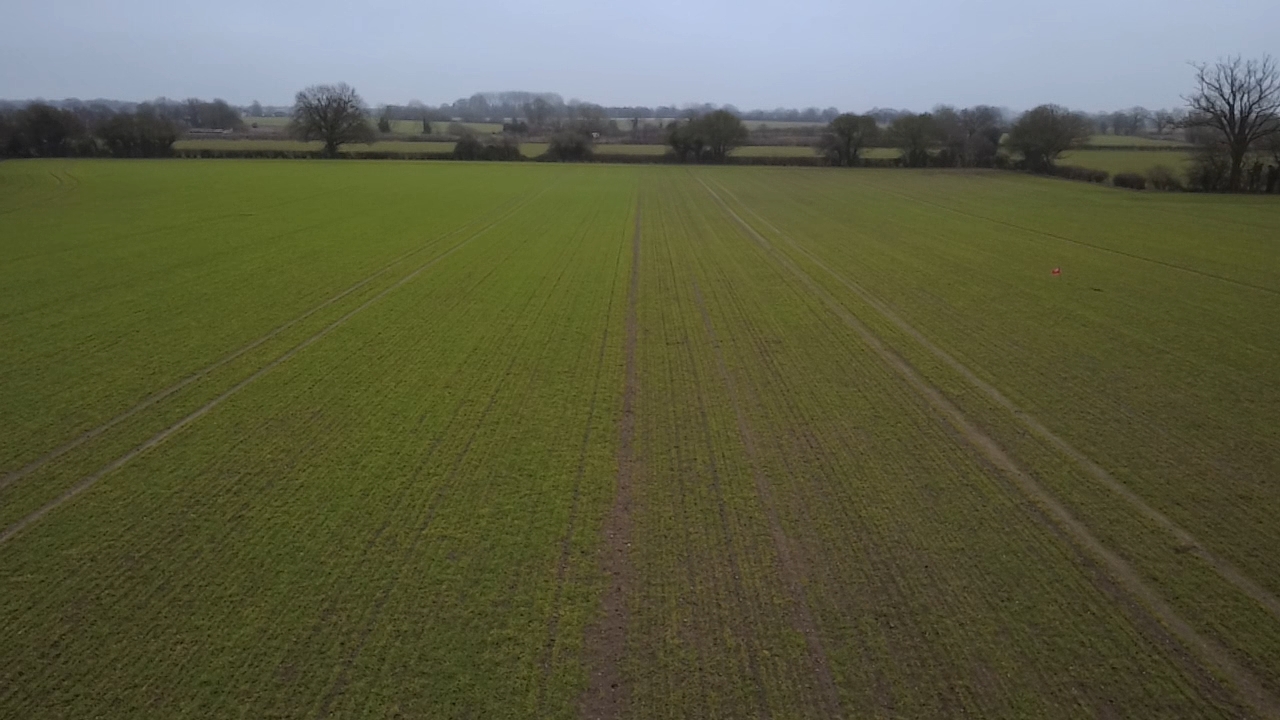
“All year I could see the line down the middle of the field where Voltek was,” he reports. “And at harvest there was more straw, less brackling and it was less brittle. The yield was slightly better.
We compared plants and the Voltek side had better root structure and increased root mass, which is why the straw was better.”
Better quality straw is important on his dairy farm for improved bedding, but also because young calves tend to eat quite a lot of straw, he says.
This year, all his winter and spring barley have been treated with Voltek. “The price at £40-45/t can scare you, but when you work it back to a price per hectare, you realise you couldn’t put much P or K down for what it costs, so I think it is very worthwhile on our farm – it just gives a little edge to getting crops established and off to a better start.”
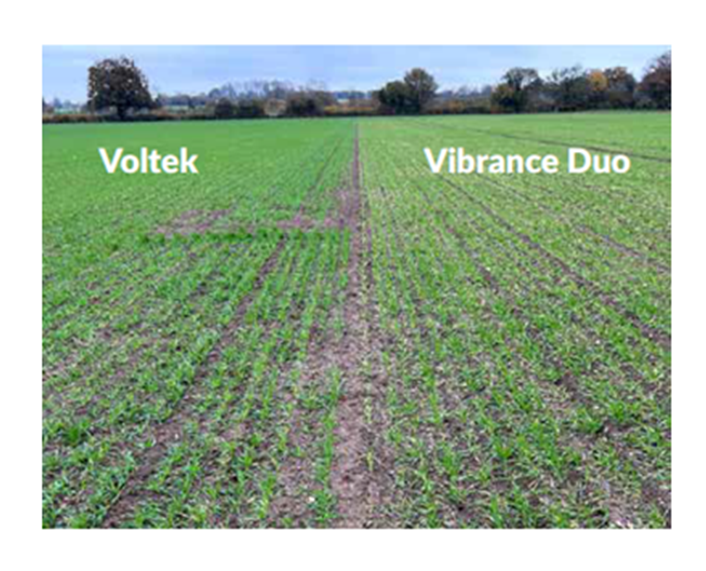
It’s a similar story in Norfolk for Richard Aldous, who has a field of winter barley part treated with Voltek after running out of seed on his 80ha farm in Banham.
While it is difficult to compare directly within the field, as the Voltek is on the variety Resolute, and the rest of the field is Tardis part treated with a single purpose, and part treated with Vibrance Duo (sedaxane + fludioxonil), Richard is impressed by the differences in rooting and general health of the crop.
“I was sceptical, but seeing is believing. Even with the varietal difference, there was a marked difference in root length and plant biomass, which you could see to the line in the autumn.”
Plant measurements made by Richard’s son, Harry, for an agricultural college project, have confirmed the differences in root length between the two sides.
By spring the differences in colour were less obvious, he says, but the amount of biomass was still increased compared with Vibrance Duo and the single purpose parts of the field.
Voltek’s performance has convinced Richard to use it more widely, starting with a field of spring barley, while he’s very likely to use it on winter barley next autumn.
“We don’t drill particularly early, usually early October, so anything that gets the crops going is a good thing,” he concludes.
Richard’s Agrovista agronomist Will Brundle is a firm believer in the benefits Voltek can bring on all cereal crops, but particularly winter barley. “I’ve been using it to get my winter barley established and away a bit better,” he says.
“Using Voltek increases above ground biomass and also rooting depth and helps the crop cope with the herbicides we’re using to control blackgrass. It’s anecdotal, but where we’ve used it this season, I’ve seen a lot less herbicide bleaching.”
Where other growers have compared it in split field trials against Vibrance Duo, he’s seen similar benefits in increased biomass, if not quicker emergence. “There wasn’t a massive difference in emergence, but the Voltek treated plants keep growing putting on more biomass.
“With winter barley getting its yield from maximising viable tillers, the more impact we can have on that in the autumn, the more benefit we should see at harvest,” he says.
West Yorkshire grower Scott Hall is finding using Voltek helps improve crop robustness and health in his wheat crops. Growing 120ha of winter wheat on some heavy soil, he says Voltek is maximising nutrient uptake.
“A big root biomass is essential to achieving full yield potential, particularly with the extreme weather in recent autumns,” he says.
His agronomist Lewis Bretton says he found it useful for ensuring emergence on those heavy soil types, including in spring barley in dry seasons. “It gets the crop going and that helps with the rest of the season.”
He’s also seen less impact from herbicides where he’s used Voltek, while another benefit, at least anecdotally, is improved seed quality. “A lot of my customers are saving their own seed to help save costs, and the seed quality seems better where Voltek was used.”
Agrovista Northern Region Seed Manager Marc Lanham likes to test our varieties and seed treatments on land close to his home in Holderness, East Yorkshire both to get a close look at the varieties and how they are performing but also to show customers periodically through the year and give guidance to the agronomists in the region.
Marc has a crop of Mindful winter wheat, an exclusive group 4 hard feed variety gaining popularity in the area and featured in this brochure.
He has treated Mindful seed with three treatments, the standard biostimulant Kick Off, Voltek and the new nitrogen-fixing seed treatment Tiros Max which also incorporates an adjusted form of Voltek, called Voltek Bio.
Looking at rooting on Mindful plants drilled 1st October 2025 it was very noticeable that the Voltek-treated and Tiros Max + Voltek Bio had longer roots than the Kick-Off and Beret Gold treated.
What is Voltek and how does it work?
Voltek, unlike other commercially available root stimulant seed treatments, contains both a phosphite and the innovative metabolite pentanoate.
Phosphite enhances nitrogen assimilation in young seedlings by increasing the activity of the key nitrate reductase enzyme, helping to build plant biomass, while pentanoate increases root biomass and length and chlorophyll production.
Voltek’s positive effects on establishment are more pronounced in less favourable conditions, as root stimulation enables better access to water and soil nutrients.
Trials by Nottingham University showed the use of Voltek consistently enhanced germination over untreated and competitor products.
It is not difficult to find examples from our customer commercial crops of the benefit of Voltek biostimulant. Whether the comparator is another biostimulant or more complex treatments such as Vibrance duo, Voltek stimulates faster root growth and bigger plants as a result. A larger root structure will build resilience when stresses hit the crop be it excessive rain or not enough.
Benefits
Enhanced germination
Increased root and shoot biomass
Improved establishment rate and crop uniformity
Increased stress tolerance including over wintering