


Group 4 hard feed wheat, Mindful, is proving a winner for farmers looking for high feed wheat yields, or livestock uses, such as whole cropping or crimping, according to Agrovista agronomist John Ball.
The variety’s flexibility is a key advantage for his farming clients in Lancashire. “They need something that is versatile,” he says. “It could be whole cropped, it could be combined, depending on the year. If it’s been a good grass-growing year, they may choose to combine it if they don’t have space to store whole cropped wheat in clamps, for example.
“You need a variety that can do both, and something you know will perform in terms of its specific weight,” he says.
A high specific weight helps with processing, making it easier to ensure every grain is broken open during harvesting. “If it is not a big grain, then it can just go straight through the harvester without being cracked. And then it will pass straight through the animal, not providing any nutritional value and effectively wasting money.
“Getting a good specific weight is key to getting a good final product.”
On farm, John is finding Mindful typically achieving specific weights in the 80s. “That’s down to its Costello parentage. Costello was a banker for high specific weights.”
Its other parent is Evolution, which John says provides good scavenging ability for nutrients. “I think that’s a key aspect of why Mindful’s yield and quality was so consistent last year, because it was able to scavenge for nutrients in a stressful year.”
Another useful characteristic for whole cropping with Mindful is its height. That provides plenty of biomass, which along with the bold grain, helps provide the maximum output.
But it is a weakness that needs looking after with growth regulators. John usually recommends a two or three spray growth regulator programme, especially where being grown for grain, starting at GS30 with chlormequat plus trinexapac-ethyl and following up as required to strengthen straw.
“With whole cropping or crimping where you’re harvesting earlier, you don’t need quite as much growth regulator as there’s less risk from storms that cause lodging later in the season. But equally you don’t want the crop to go flat, because it’s then really hard for the whole crop header to pick up.”
Agronomically Mindful is strong, with decent eyespot resistance, excellent mildew resistance, and importantly good septoria scores and yellow rust resistance that appears unaffected by the Yr15 resistance gene breakdown.
“It wasn’t as susceptible to the yellow rust outbreak as I saw in Dawsum and Extase,” John recalls.
Where it’s been grown for whole crop John still advises a full fungicide programme, although the T3 could be manipulated depending on harvest date. “If you’re going to take it when the grain still has a bit of moisture left in, you might treat it slightly differently to taking it when the grain is closer to being fully ripe.”
But while there might be some scope to reduce spend at T3, John is adamant that cutting it out entirely can jeopardise both yield and quality. “It’s important to get right because the cheapest way to feed your cows is through what you can grow at home.”
Yields of whole crop Mindful should be around 25t/ha, while grain yields of 10t/ha have been consistently achieved on his clients’ farms, John says. “It’s been an ideal replacement for Extase and Dawsum type varieties, where the specific weight can be inconsistent.
“A lot of my growers have really liked it – it outyielded most other varieties last year, and it can be grown as a first or second wheat, and drilled early or late, giving a huge amount of flexibility,” he concludes.
Establishment Plus
Mindful seed will be part of Agrovista’s Establishment Plus scheme, which uses the biostimulant, 3ALO T6P, as a foliar treatment in the seed crop to enhance the mobilisation and translocation of sucrose into developing grain.
“It’s helping make sure the seed we produce, and sell is top quality,” John says.
Trials showed that the seed produced up to 15% more plants / sqm as a first wheat in autumn, improved biomass, increased ear counts, and delivered 8% higher yields compared with seed not treated with the biostimulant.
Dairy farmer finds Mindful success
Crimped Mindful wheat has proven to improve cow health and milk yields for Lancashire dairy farmer John Norris.
Home to a 350-strong milking herd, plus followers on the 288ha family farm in Hornby, the business switched to crimped wheat as a feed source around five years ago, John explains.
“We were buying a lot of caustic wheat in, but prices were creeping up, so my brother Andrew, sadly no longer with us, suggested we crimp some.”
Crimping involves harvesting a standing wheat crop with a combine at higher moistures, typically around 25-30%, crushing the grain through roller, adding a preservative, Crimpsafe, and then storing in a clamp until required.
“Since we started using it, I have not seen one grain come through in the muck. It helps with the cow’s digestion and pushes milk yield up a little,” he says.
In contrast, caustic wheat was less consistent. “Sometimes we would get a new load, and a lot of grain would be coming through while the cows were milking in the parlour.”
As importantly, cow health has improved when fed with crimped wheat. “They’re coming to bulling better, while the fattening stock love it. Everything is being digested and it’s a lot healthier for the cows,” he says.
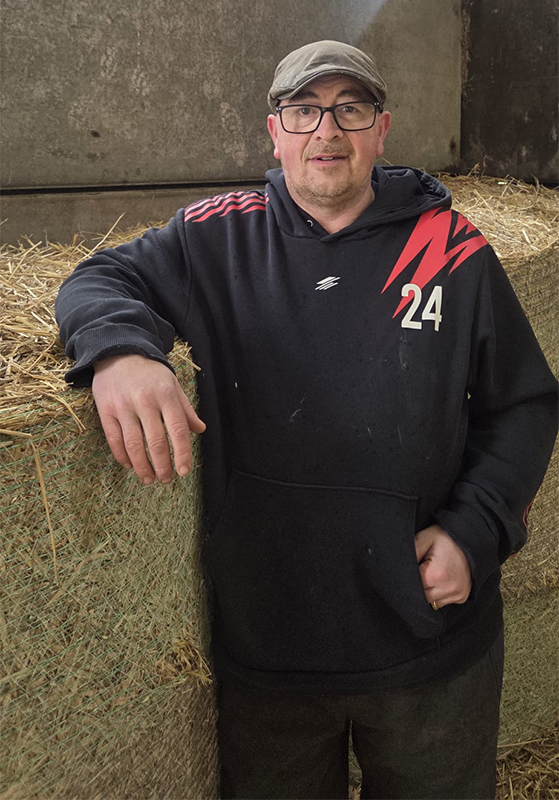
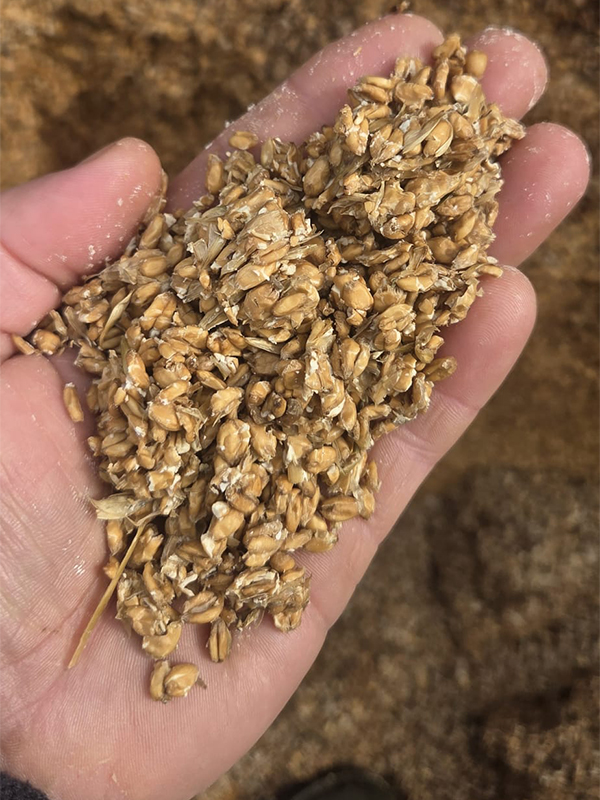
This season is his second year growing Mindful winter wheat for crimping. It was chosen as a replacement for a previous variety that had underperformed leading to John needing to buy some caustic wheat to feed part way during the year. “We only produced about 300t from around 40h, so we needed to find a better alternative.”
Last year, Mindful delivered. “It was a fantastic crop,” John says. “It gave us plenty of straw and grain, so I was very impressed.”
Grain yield, albeit at a much higher moisture content than traditional combine yields, was just under 12t/ha with a final crimped tonnage of 520t from 41ha, while the variety also produced 639 dry straw bales and 324 treated and wrapped bales that are fed to young stock.
The crop looked good all season, John recalls, even having good resilience to flooding, which is common on his farm located in the Lune Valley. “We need a variety that gets going in the autumn and produces good, strong rooted plants.”
That strong growth does mean growth regulation is required but with John looking for both high straw and grain yield, a vigorous variety is more positive than negative. “It will grow and grow, so if you don’t manage it, lodging is a risk. But by harvesting sooner we reduce the risk.”
The main challenge last year was there was so much grain that he needed the crimper contractor to come earlier than planned as he was running out of room on the storage pad. “It was a good problem to have,” John says.
With another 42ha in the ground this year, he hopes for continued success with Mindful. “As soon as we finished last harvest, I was making sure there was enough seed for me – I wasn’t missing out,” he says.
And even with current wheat prices much lower than when the farm first started crimping, he’s not going back to using caustic wheat for feed. “Even if wheat prices dropped through the floor, I don’t think I would go back,” he concludes.